Addressing barriers to mental health access for Black Refugees in Peel region: designing equitable pathways and establishing a Refugee-led health research collaborative.
About the Project
Since 2022, Canada has welcomed an unprecedented number of refugees, with Peel Region serving as a key settlement destination. With 60% of residents identifying as racialized and 51% as immigrants, growing newcomer arrivals have placed increasing pressure on local settlement and shelter systems, with over 91% of shelter residents identifying as being of African origin.
For refugees, the mental health and settlement journey is shaped by experiences across the pre-migration, migration, and post-migration periods. Trauma, displacement, uncertainty, financial insecurity, social isolation, and barriers to culturally responsive supports can compound over time, affecting wellbeing, access to services, and the ability to thrive in new communities.
Building on earlier research conducted with the Peel Newcomer Strategy Group, Mississauga Ontario Health Team, and Region of Peel, mental health emerged as an urgent priority among Black refugees and a cross-cutting factor influencing their overall settlement experiences.
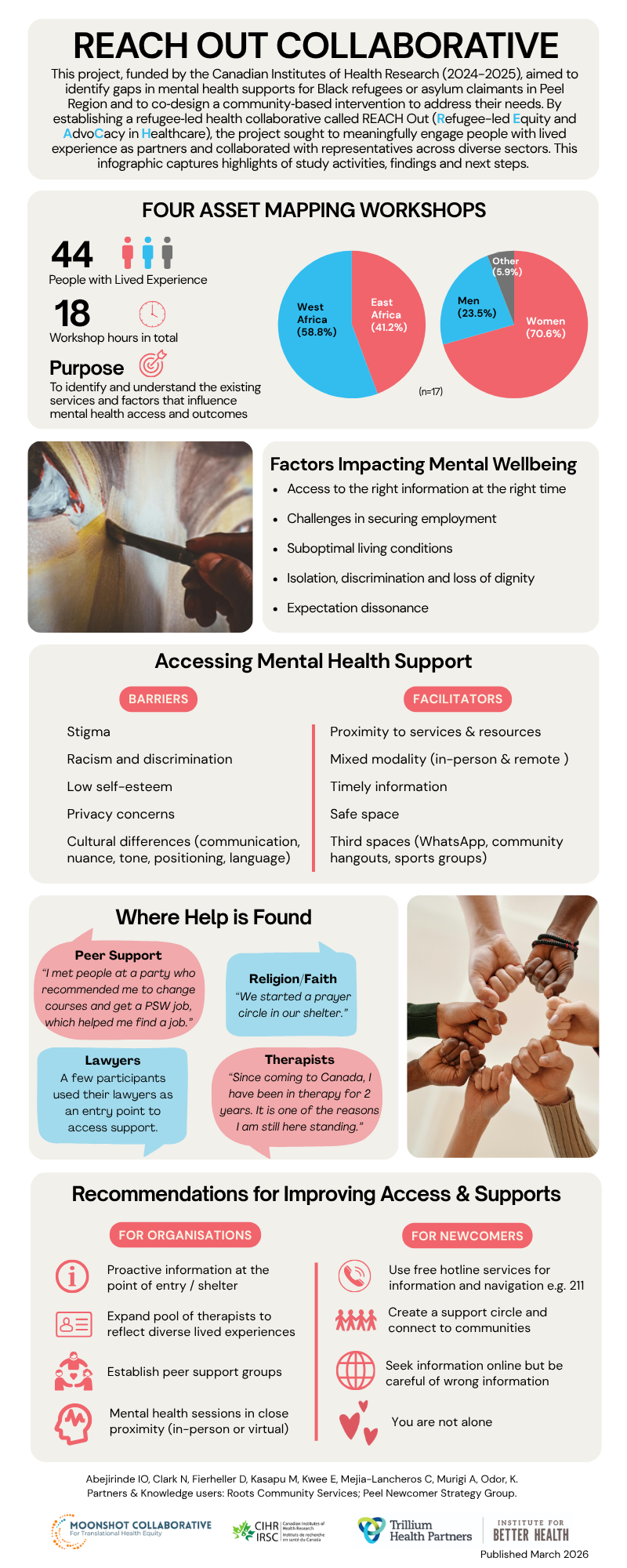
This initiative established a refugee-led health research collaborative as a platform for partnership, knowledge exchange, and shared learning among Black refugees, community organizations, researchers, and system partners to identify gaps in mental health supports and co-design a community-based health intervention to strengthen mental wellbeing and the settlement experience.
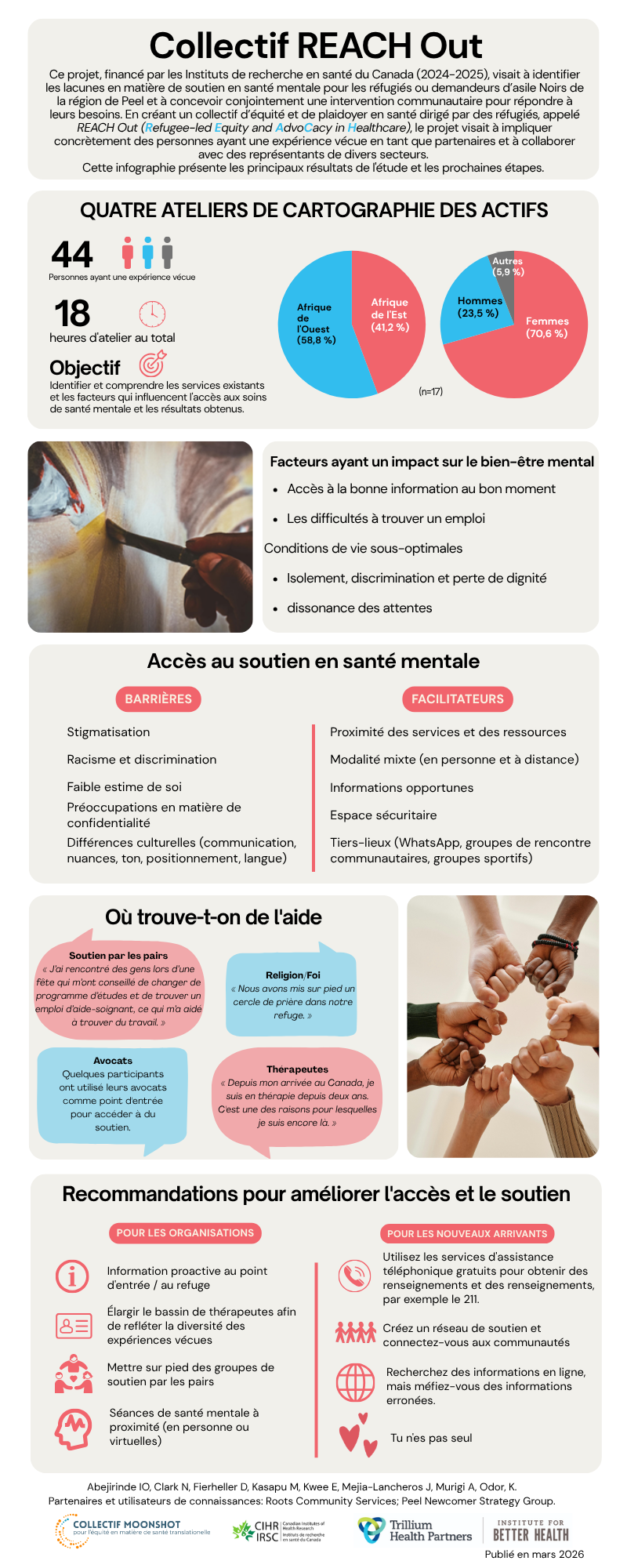
Knowledge Products
-
November 2024 - October 2025
-
Dr. Ibukun Abejirinde, Project Lead, Institute for Better Health, Trillium Health Partners
Dr. Diana Fierheller, Co-investigator, Institute for Better Health, Trillium Health Partners
Dr. Cilia Mejia-Lancheros, Co-investigator, Institute for Better Health, Trillium Health Partners
Dr. Nancy Clark, Co-investigator, University of Victoria
Elaine Kwee, Research Assistant, Institute for Better Health, Trillium Health Partners
Salva Niwe, Research Assistant, Institute for Better Health, Trillium Health Partners
Patricia Nderitu, Peer Research Assistant, Institute for Better Health, Trillium Health Partners
Shane Joseph, Roots Community Services
Jessica Kwik, Peel Newcomer Strategy Group
Miyanda Kasapu, Lived Experience Co-Investigators
Abigal Murigi, Lived Experience Co-Investigators
Kenneth Odor, Lived Experience Co-Investigators
-
For more information about this project, contact: info@moonshotcollaborative.ca
Project Collaborators

Funders