Food and Culture as Healing: An Intergenerational Community Garden to Address the Burden and Impacts of Type-2 Diabetes in Black Communities
About the Project
Black communities in Peel Region, Ontario experience a disproportionate burden of Type 2 diabetes (T2D), shaped by structural barriers including food insecurity, inequitable access to culturally responsive care, and systemic anti-Black racism. Mainstream approaches to address T2D often overlook the cultural, social, and historical contexts that shape Black communities’ health and experiences of care.
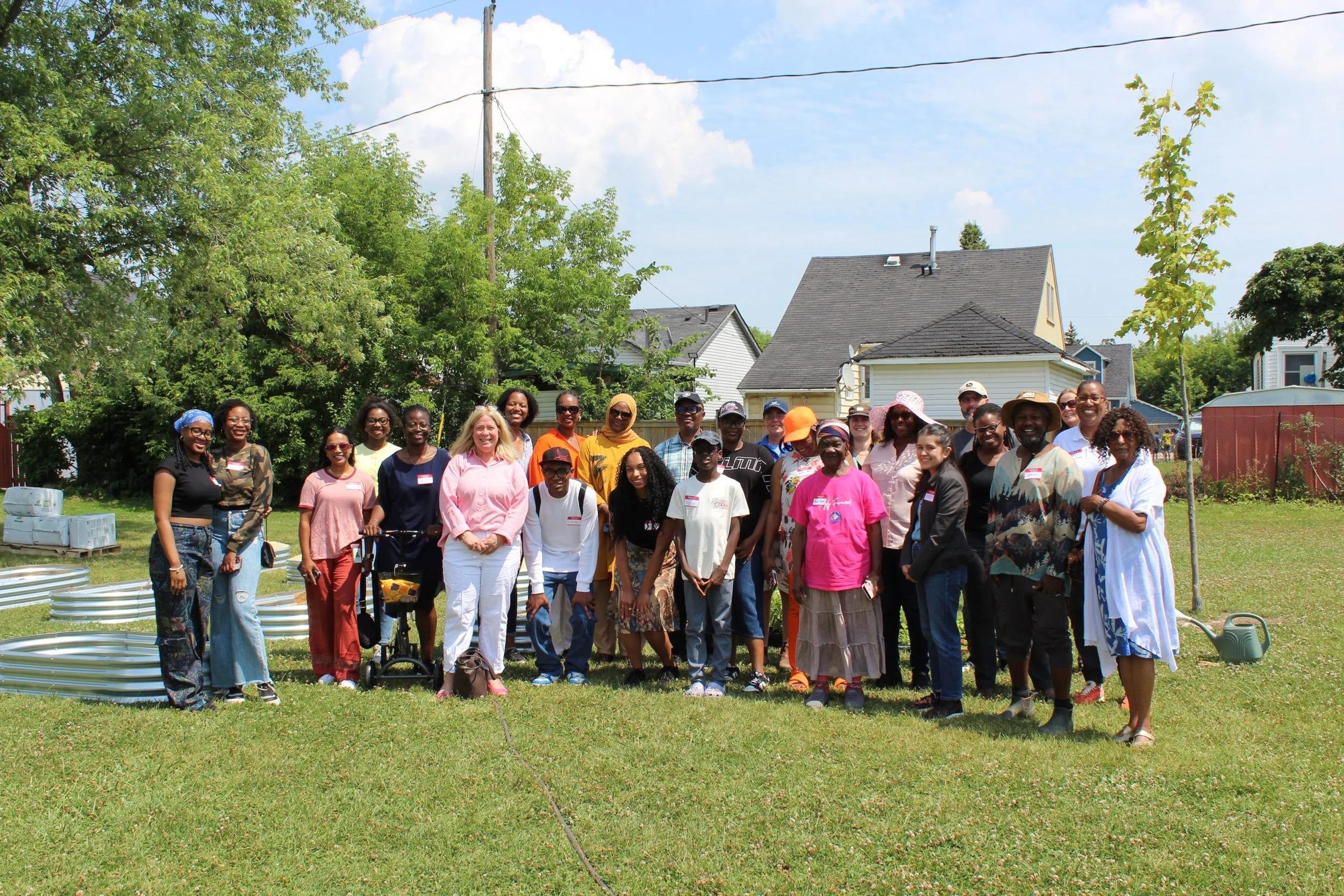
In response to this gap, Moonshot Collaborative, in partnership with the Black Health and Social Service Hub and LAMP Community Health Centre, launched the Food and Culture as Healing Intergenerational Community Garden Project. The project aims to assess the feasibility, acceptability, and appropriateness of implementing and sustaining an intergenerational community garden in Malton, Mississauga, to support T2D prevention and management. Malton was selected as the project site due to significant health and social inequities, including a high proportion of racialized residents, elevated diabetes rates, limited access to healthy food environments, and low walkability.
The garden brings together Black youth (ages 15–29) and older adults (60+) to grow culturally familiar and nutritious foods, strengthen social connections, and learn about T2D prevention and care through an Afrocentric lens. Now in its second season, the project builds on lessons learned from year one. Participant feedback that standardized surveys did not fully capture their experiences led to a refined arts-based evaluation approach, including asset mapping, photo elicitation, focus groups, and interviews. Findings will deepen understanding of the garden’s impact on physical, mental, and social wellbeing, while identifying opportunities to strengthen community partnerships and advance alignment with the Mississauga Healthy City Strategy.
The project is incorporating arts-based methods, including asset mapping and photo elicitation workshops, to generate rich and meaningful data on participants' experiences and perspectives of the garden. Researchers are also analyzing qualitative and quantitative data collected during the first garden season, conducting focus groups with garden participants, and holding interviews with family and friends of participants as well as with project partners.
Knowledge Products
-
May 2025 - December 2026
-
Dr. Ibukun Abejirinde, Project Lead, Institute for Better Health, Trillium Health Partners
Racquel Bremmer-Miller, Project Lead, Black Health and Social Services Hub, Peel
Julia Bonsu, Research Assistant, Institute for Better Health, Trillium Health Partners
Naomi Ihama-Anthony, Research Trainee, Institute for Better Health, Trillium Health Partners
Souad Hamid, Community Health Ambassador, Black Health and Social Services Hub, Peel
Shamika Green-Rose, Registered Dietician, LAMP Community Health Centre
Thelma Dawn Paris, Community Garden Expert, LAMP Community Health Centre
-
For more information about this project, contact: info@moonshotcollaborative.ca
-
Bonsu, J. Gerstle, D. Bremmer, R. Abejirinde, I. Community Gardens as a Medium to Address the burden of non-communicable diseases in Black Communities: A review at the Intersection of Food, Culture and Health . [In Progress].
-
Bonsu R, Abejirinde I, Bremmer-Miller R. (May 2026). Community Gardens as a Medium to Address the burden of non-communicable diseases in Black Communities: A review at the Intersection of Food, Culture and Health. [Oral Presentation]. Canadian Association for Health Services and Policy Research Conference. Ottawa, Canada.
Bonsu R, Abejirinde I, Bremmer-Miller R. (June 2026) Food and Culture as Healing: An Intergenerational Community Garden to Address the Burden and Impacts of Type-2 Diabetes in Black Communities. [Poster]. Discovery Summit: From Vision to Impact. Mississauga, Ontario.
Ihama-Anthony N, Abejirinde IO, Bremmer-Miller R. (August 2026). Food and Culture as Healing: An Intergenerational Community Garden to Address the Burden and Impacts of Type-2 Diabetes in Black Communities. [Oral Presentation]. NHP Summer Student Research Day, Toronto, Ontario.
-
Project Spotlight: Food and Culture as Healing: An Intergenerational Community Garden
Project Collaborators

Funders
Media and Engagement